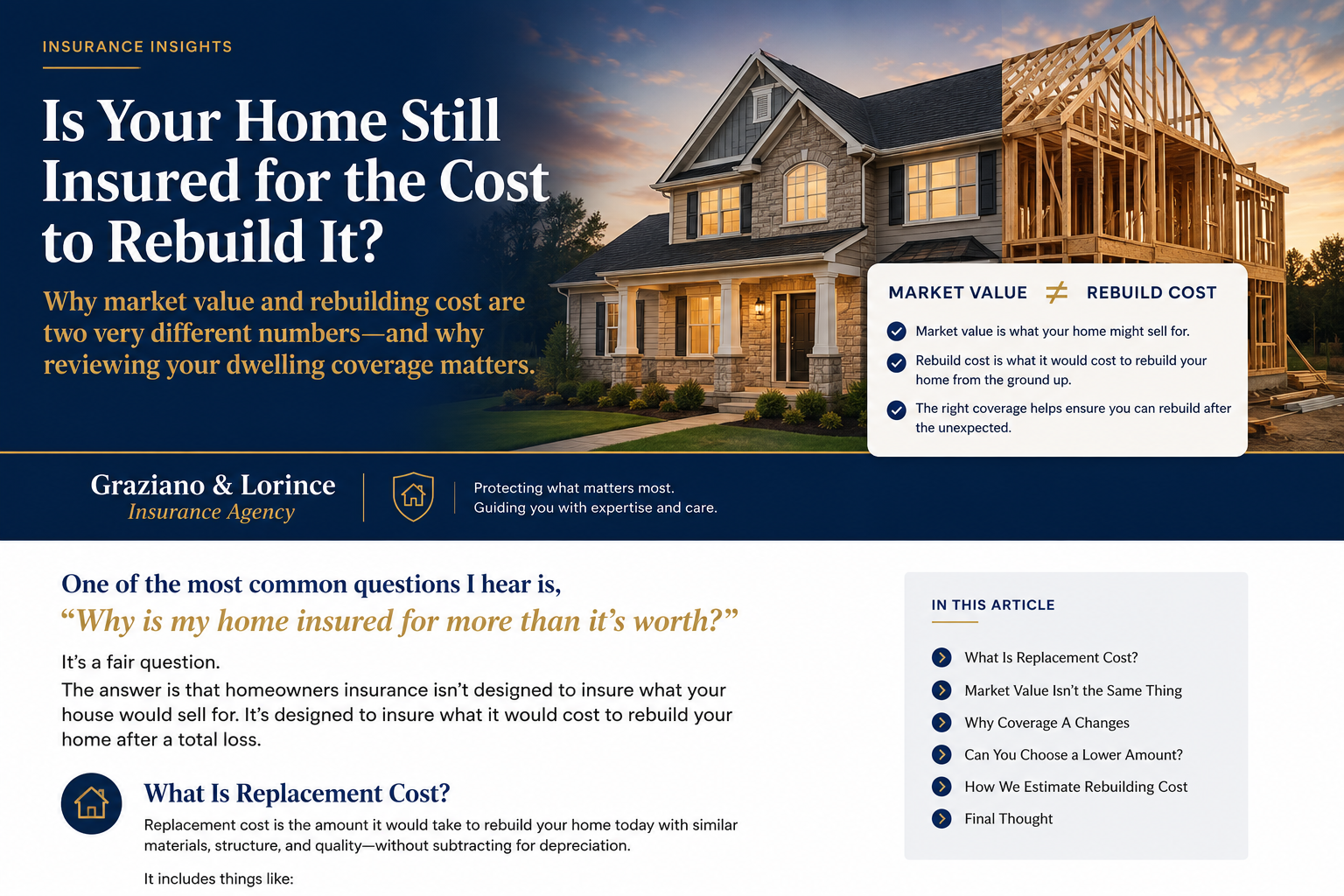

One of the most common questions homeowners ask is:
“Why is my home insured for more than it’s worth?”
It is a fair question.
The answer is that homeowners insurance is generally not designed around what your house might sell for on the real estate market. Its primary purpose is to help cover what it could cost to rebuild your home after a major covered loss.
Those two numbers—market value and rebuilding cost—can be very different.
What Is Replacement Cost?
Replacement cost is an estimate of what it would take to rebuild your home today using materials and construction of similar type and quality, subject to the terms, conditions, and limits of your policy.
Rebuilding a home may involve much more than simply purchasing lumber, shingles, drywall, and flooring. The total cost can also include:
- Construction labor
- Architectural or engineering services
- Demolition and debris removal
- Building permits and inspections
- Updated building-code requirements
- Plumbing, electrical, and mechanical systems
- Interior finishes, cabinetry, flooring, and fixtures
- Temporary demand for contractors and materials after a major storm
This is one reason the amount shown as Coverage A on a homeowners policy may not match the price you paid for your home or the amount shown on a real estate website.
Your home’s insurance value is intended to reflect rebuilding costs—not necessarily its resale value.
Market Value Is Not the Same as Rebuilding Cost
Market value is influenced by factors that may have little to do with the physical cost of rebuilding the house itself.
The price a buyer may be willing to pay can be affected by:
- The neighborhood
- The school district
- The amount and location of the land
- Current housing demand
- Mortgage rates and economic conditions
- Comparable home sales nearby
The cost to rebuild, however, is based more heavily on the structure itself and the current price of labor and materials.
For example, a home might sell for $350,000 but require substantially more than that to rebuild from the ground up. The opposite can also occur in an area where the land makes up a large portion of the property’s market value.
Market Value vs. Rebuilding Cost
What a buyer may pay for the home and property.
What it may cost to reconstruct the home after a covered total loss.
Why Does My Dwelling Coverage Increase?
Homeowners sometimes become concerned when the dwelling limit on their renewal policy increases, especially when they have not remodeled or added onto the home.
Insurance companies may apply inflation adjustments to help the policy keep pace with changing construction costs. Labor rates, material prices, building-code requirements, and local rebuilding expenses can all change from year to year.
An increase in Coverage A does not necessarily mean the insurance company believes your home’s real estate value increased by the same amount. It may simply reflect updated estimates of what a reconstruction project could cost.
These automatic increases are helpful, but they are not always a substitute for a detailed review—particularly when a home has undergone significant renovations.
How Do Insurance Agents Estimate Rebuilding Cost?
Insurance agencies and carriers commonly use a replacement cost estimator to develop an estimated rebuilding value for a home.
Depending on the estimator and insurance company, the calculation may consider:
- Square footage
- Year of construction
- Number of stories
- Exterior construction
- Roof type and shape
- Basement size and level of finish
- Number and quality of kitchens and bathrooms
- Flooring, cabinetry, fireplaces, and interior finishes
- Attached garages, porches, decks, and other features
- Local labor and construction costs
The accuracy of the estimate depends heavily on the accuracy of the information entered.
A basic builder-grade home and a custom-finished home of the same square footage may require very different amounts of money to reconstruct.
Can You Choose a Lower Dwelling Limit?
Homeowners sometimes ask whether they can simply lower the dwelling limit to reduce the premium.
The answer depends on the insurance company, the policy, and the estimated replacement cost of the home. Many carriers require the dwelling to be insured to a certain percentage of its estimated replacement value to qualify for replacement cost coverage or certain additional coverage provisions.
Reducing the limit too far could create a serious gap after a major loss. It may also affect how the policy responds to a partial loss, depending on the policy’s insurance-to-value requirements.
A lower dwelling limit is not always a harmless way to lower the premium.
Before changing it, ask how the reduction could affect replacement cost coverage and the settlement of a future claim.
Home Improvements Can Change the Rebuilding Cost
Your current dwelling limit may no longer be accurate if you have made substantial improvements since the policy was originally written.
Consider contacting your insurance agent after completing projects such as:
- A major kitchen renovation
- A bathroom remodel
- Finishing the basement
- Adding a room or expanding the house
- Installing custom cabinetry or upgraded finishes
- Building an attached garage
- Adding a large deck, porch, or outdoor living space
These improvements may add value to the home, but more importantly for insurance purposes, they may increase the amount it would cost to rebuild.
What About Extended Replacement Cost?
Some homeowners policies include extended replacement cost protection. This may provide an additional percentage above the stated dwelling limit when rebuilding costs exceed the original estimate after a covered loss.
Other policies may offer guaranteed replacement cost, although availability and eligibility vary considerably by carrier and property.
These features can provide important additional protection, but they do not mean the original dwelling estimate can be ignored. Policy conditions and insurance-to-value requirements still apply.
It is important to review the exact language of your policy rather than assuming every homeowners policy provides the same protection.
The Bottom Line
Homeowners insurance is not designed to predict what your house would sell for tomorrow.
It is designed to help protect you against the financial cost of repairing or rebuilding your home after a covered loss.
That is why your dwelling coverage may be higher—or sometimes lower—than the property’s market value.
The important question is not:
“Does this number match what my home is worth?”
The better question is:
“Would this coverage be enough to rebuild my home properly?”
Not Sure Whether Your Dwelling Coverage Is Still Accurate?
Whether you have renovated your home, added upgraded features, or simply have not reviewed your policy recently, Graziano & Lorince Insurance can help you take another look.
Coverage varies by insurance company and policy. This article is intended for general educational purposes and does not alter, expand, or replace the terms, conditions, limitations, or exclusions of any insurance policy. Please review your policy and speak with a licensed insurance professional regarding your specific coverage.

