
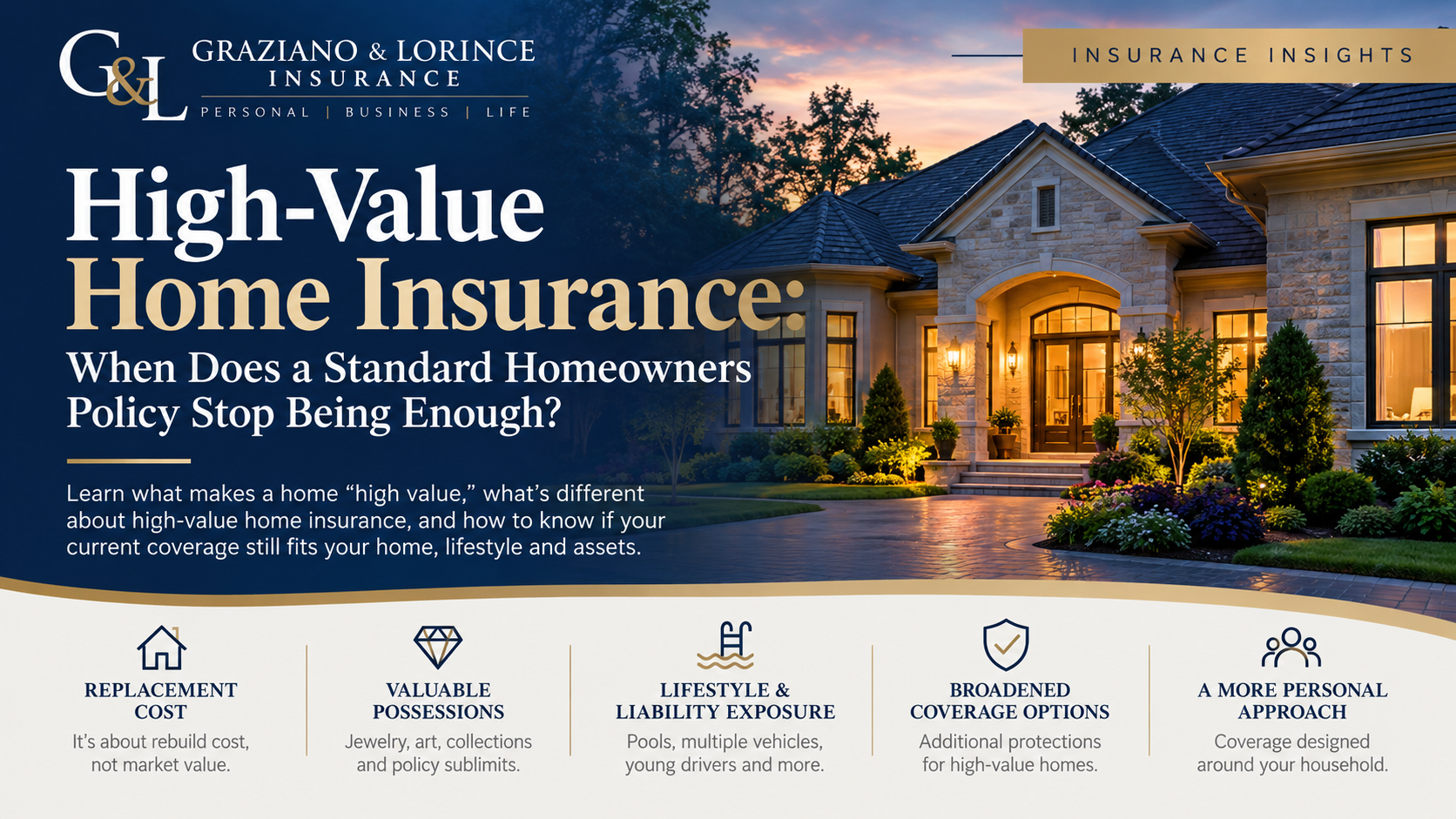
A beautiful home is more than an address. It represents years of hard work, personal investments and a lifestyle you’ve built. But as the value and complexity of your home and assets increase, is your homeowners insurance keeping pace?
For many families in Northeast Ohio, a traditional homeowners policy provides excellent protection. However, higher rebuilding costs, valuable possessions and additional liability exposures can make a closer look worthwhile.
That’s where high-value home insurance enters the conversation. The question isn’t simply whether your home is expensive. It’s whether your policy is properly designed for everything you need to protect.
What Is High-Value Home Insurance?
High-value home insurance generally refers to homeowners coverage designed for properties with substantial reconstruction costs, custom features or more complex insurance needs. Some insurers offer specialized policies, while others accommodate higher-value homes through traditional homeowners policies with suitable limits and endorsements.
There is no universal dollar amount that automatically makes a home a high-value property. Eligibility thresholds and underwriting requirements vary by company. What matters is the cost to rebuild the home, its construction, the value of its contents and the household’s broader insurance needs.
7 Signs Your Homeowners Insurance Deserves a Closer Look
1. Your Home Would Be Expensive to Rebuild
One of the most important distinctions in homeowners insurance is the difference between market value and reconstruction cost. Market value reflects what someone might pay for your property. Reconstruction cost considers what it would take to rebuild the insured dwelling after a covered total loss, including applicable labor, materials and construction expenses.
A custom home with detailed millwork, imported stone, specialty roofing or unusual architectural features may cost considerably more to reconstruct than a similarly sized conventional home. We explored this in our article about rebuilding cost versus market value.
What to review: Your dwelling limit, the assumptions behind the replacement-cost estimate and any available extended or guaranteed replacement-cost provisions.
2. Your Home Has Custom or High-End Features
Custom kitchens, hardwood finishes, elaborate trim, specialty windows, built-in cabinetry and architectural details can make a home more complicated to restore. Even when the dwelling limit appears adequate, valuation methods and policy provisions deserve attention.
Some specialty policies offer broader coverage features or additional flexibility for qualifying homes, but those benefits are not universal.
What to review: Whether unique materials, finishes, renovations and construction characteristics are reflected accurately in the insurer’s replacement-cost estimate.
3. Your Jewelry, Art or Collections Have Grown in Value
Certain valuable belongings may be subject to special policy limits, particularly for specific causes of loss such as theft. Depending on the policy, these can include:
- Fine jewelry and luxury watches
- Artwork and collectibles
- Silverware and precious metals
- Rare coins and other specialized collections
Personal property coverage does not necessarily mean every item is fully protected against every type of loss. Scheduling items or obtaining specialized valuables coverage may be appropriate.
What to review: Special limits, covered causes of loss, valuation terms and whether individual items should be scheduled.
4. Your Lifestyle Creates Additional Liability Exposure
A household with a swimming pool, multiple vehicles, teenage drivers or recreational equipment may face liability exposures that deserve careful attention. A serious accident or lawsuit can potentially exceed the liability limits of an underlying home or auto policy.
Personal umbrella insurance may provide additional liability protection above qualifying underlying policies, subject to its terms, exclusions and required underlying limits.
What to review: Home and auto liability limits, umbrella coverage and whether relevant exposures are addressed.
5. Your Household Owns Multiple Properties or Specialty Assets
Second homes, vacation properties, rental real estate, collector vehicles and boats can create needs that a primary homeowners policy does not address. Each asset may need its own policy, and coordinating liability protection across policies matters.
What to review: Whether properties and vehicles are insured appropriately and whether gaps exist between policies.
6. Your Home Has Undergone Major Improvements
A kitchen renovation, finished basement, addition or outdoor living area may increase rebuilding costs. Homeowners do not always think to update their insurance after completing these projects.
Roof replacements can also affect eligibility, pricing or roof-loss settlement provisions with some insurers. Learn more in our article about reporting a new roof to your insurance agent.
What to review: Recent improvements, their effect on reconstruction cost and whether the insurer needs updated information.
7. Your Insurance Hasn’t Been Reviewed as Your Assets Have Grown
Over time, families may purchase more valuable homes, accumulate savings and investments, acquire vehicles or properties, and take on new responsibilities. An insurance program established years ago may no longer reflect the household it was designed to protect.
What to review: The home, auto, umbrella and specialty insurance program together—not just the homeowners premium.
An Important Distinction
Owning an expensive home does not automatically mean you need a specialty insurer. A well-designed traditional homeowners policy may be appropriate. The goal is to match coverage to the property, household and risks—not to purchase a particular label.
How Is High-Value Home Insurance Different From Standard Coverage?
Depending on the insurer and eligibility requirements, specialty high-value homeowners programs may offer:
- Higher available dwelling and personal property limits
- Broader or more flexible replacement-cost provisions
- Specialized coverage for valuable possessions
- Additional loss-prevention services
- Coverage options for complex or custom properties
- Specialized claims assistance and restoration resources
These features are not guaranteed, and some are available from traditional insurers or through endorsements. Comparing actual policy language is more useful than comparing product names alone.
Why an Independent Insurance Agent Can Make a Difference
Insurance for a higher-value home is about more than finding the lowest premium. It involves reviewing construction details, reconstruction cost, valuable possessions, liability exposure and how policies work together.
An independent agency can compare options among the insurers it represents, review available endorsements and explain meaningful differences. At Graziano & Lorince Insurance, we believe a comprehensive review should consider the household as a whole—not simply renew each policy in isolation.
Protecting Higher-Value Homes in Northeast Ohio
From established neighborhoods in Brecksville and Hudson to communities around Macedonia, Sagamore Hills and the surrounding Northeast Ohio area, homeowners have a wide range of properties and insurance needs.
Whether your home is newly purchased, custom-built, renovated or one you’ve owned for years, a periodic insurance review can help ensure coverage remains aligned with your circumstances. And if your home, vehicles, investments or other assets have grown in value, it may be time to look beyond the homeowners policy alone.
Does Your Insurance Still Fit Your Home and Lifestyle?
Graziano & Lorince Insurance can help review your home, auto, umbrella and other coverage needs to determine whether your current protection remains appropriate.
Insurance coverage, eligibility, limits, exclusions and endorsements vary by insurer and policy. This article is general educational information and does not amend or guarantee coverage. All coverage is subject to the issued policy’s terms and conditions.